News Center
contact details
 Ollies (Guangzhou) Recreation and Sports Equipment Co.
Tel: (020) 82686289
Fax: 020-82694853
Headquarter: No.31-37, Xincun 2 Road, Shangjiang North Street, Dongzhou Village, Xintang Town, Zengcheng City, Guangzhou, Guangdong, China
2025 Three trends in high-end villa water feature design: a revolution in functional aesthetics centered on fishponds
In the field of high-end villa landscape, water feature design is undergoing a deep transformation from "decorative element" to "ecological art system". With the penetration of the concept of sustainable development and the iteration of intelligent technology, the fish pond water feature in 2025 has broken through the framework of traditional courtyard landscaping, and become a multi-dimensional carrier that integrates ecological balance, intelligent interaction and spatial narrative. This article will focus on three core trends and analyze the key role of filtration system as the "invisible guardian".
Trend 1: Deep integration of natural symbiosis and intelligent technology
1.1 Bionic form and ecological material dominance
The design of the 2025 Fishpond eschews geometric shapes in favor of parametric algorithms that mimic the curves of natural waters. The "organic walls", realized through 3D printing, retain the texture of natural stone while embedding a self-cleaning nano-coating. The bottom of the pool is made of layered volcanic rock and activated calcium sand, forming a natural mineral release system.
1.2 Closed loop intelligent ecological monitoring
Through the pre-buried IoT sensor matrix at the bottom of the pool, the system can track 15 water quality parameters in real time (including ORP redox potential, TDS dissolved solids, and other professional indicators), and linkage to adjust the working status of the UV sterilization module and the microbial reaction bin. Through the holographic projection interface, the owner can view in-depth data such as the health of the fish population and the historical curve of water quality.
Filtration System Innovation Points: The modular bioreactor is designed with biomimetic gill structure, which increases the ammonia nitrogen treatment efficiency up to 3 times of the traditional system through multi-layer alternating aerobic/anaerobic treatment units. Intelligent algorithm automatically adjusts the water flow rate according to fish density to ensure the best active environment for nitrifying bacteria.
Trend 2: Multi-dimensional spaces and immersive sensory experiences
2.1 Dissolution of the boundary between the building and the water body
The breakthrough "suspended water curtain" technology allows the water body of the fish pond to extend to the building façade, and through the micro-circulation pump in the special glass interlayer, it realizes the free swimming of koi between the vertical wall and the horizontal pond. At night, the fiber-optic light guide system simulates the luminous trajectory of deep-sea creatures, forming a dynamic light and shadow art installation.
2.2 Five Senses Interaction Experience Design
The new generation fish pond is equipped with an ultrasonic fogging device that releases water mist containing negative oxygen ions at regular intervals, forming a customized olfactory scene with aromatic plants planted around the pond. The underwater microphone beautifies the sound of fish swimming and water flow, and then creates a three-dimensional sound field through a hidden sound system.
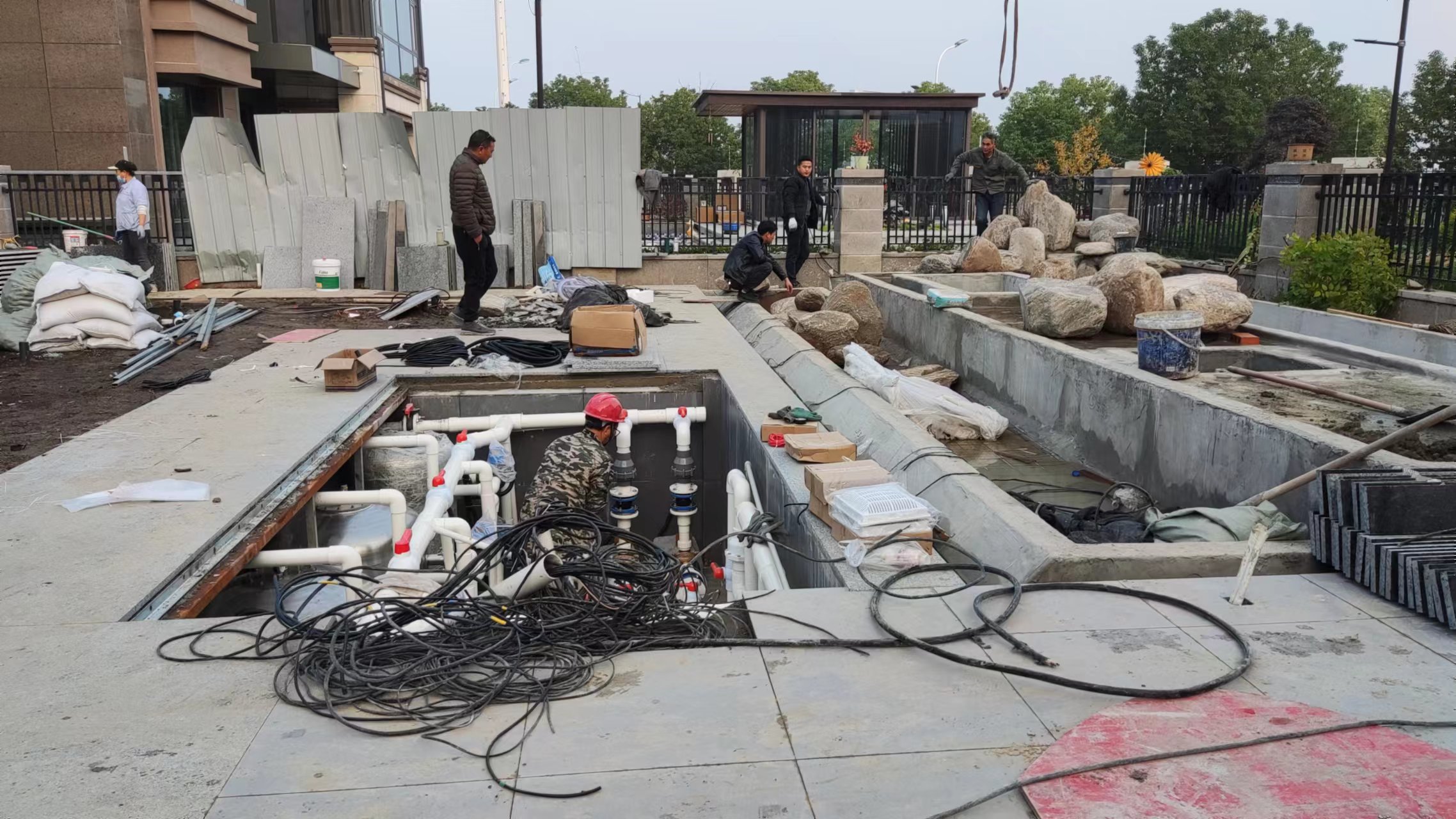
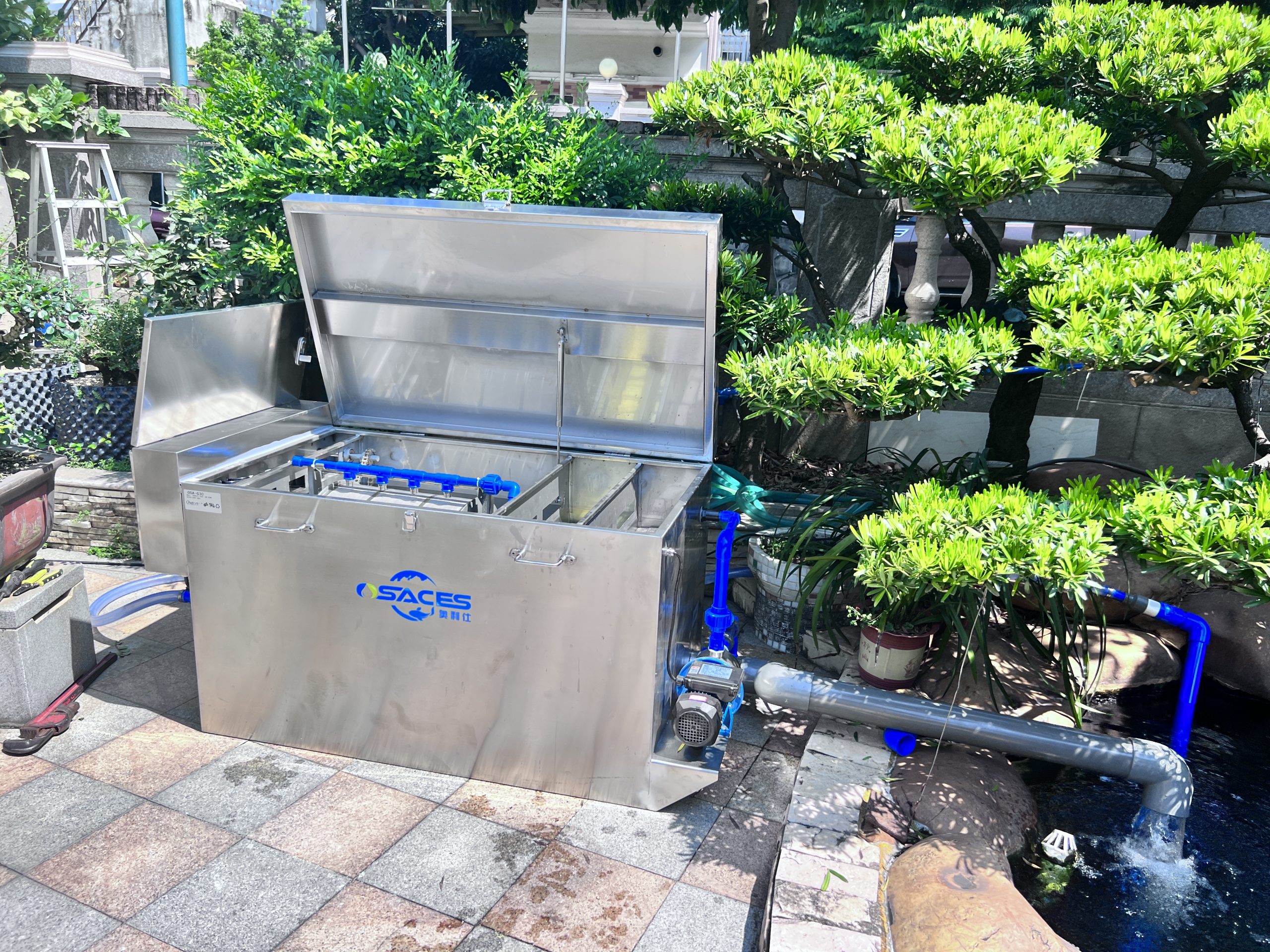
Filtration System Integration Program: Underground double-layer filtration bin structure is adopted, the upper layer is the mechanical filtration area (integrated hair collector with rotating sedimentation tank), and the lower layer is the biological purification area (nitrification system). Silent pump body with shock-absorbing base ensures that the operating noise is less than 25 decibels.
Trend 3: Sustainable Art and Functional Iteration
3.1 Ecological chain water feature system
Pioneer designers upgraded the fish pond into a miniature wetland ecosystem: koi excreta are transformed into plant nutrients by earthworm decomposition, and the roots of hydroponically grown plants absorb the nutrient-rich water, with the clean water eventually flowing back into the pond. This "fish - earthworm - plant" three-stage cycle model makes the water change cycle extended to 120-180 days.
3.2 Emergency ecological protection systems
In response to the frequent occurrence of extreme weather conditions, high-end fish ponds will be equipped with an "eco-safety mode" as standard in 2025. When the sensor detects a rainstorm warning, the siphon surface overflow device is automatically activated, while the filtration system is switched to a high-flow sewage state, preventing drastic fluctuations in the pH of the water body from causing stress to the fish.
Filtration system breakthrough: The application of graphene ultrafiltration membrane enables the filtration precision to reach 0.01 micron, which can effectively intercept fish disease pathogens. The emergency power supply system can maintain a 72-hour base cycle in the event of a power outage, and the accompanying mobile APP provides real-time troubleshooting and global expert connectivity support.
The invisible value that cannot be ignored: the evolution of filtration system design logic
In 2025, high-end fish pond filtration has evolved from an "accessory" to a core consideration at the beginning of the design process, presenting three main features:
- Spatial pre-embedding
In the schematic design stage, the filtering space that accounts for 15%-20% of the total water volume is reserved, and the pipeline direction is optimized through BIM modeling to avoid destroying the integrity of the landscape by later transformation. - energy efficiency revolution
The use of photovoltaic-driven magnetic levitation pumps, combined with AI to learn the owner's usage habits, can save up to 40%-65% of electricity throughout the year.The waste heat recovery system can transfer the heat of the equipment's operation to the pool water thermostat. - Aesthetic fusion
The outlet of the filtration bin is designed as a "falling water landscape stone", so that the functional outlet is transformed into a visual focal point; the control panel is hidden inside the landscape sculpture, and the operation interface is awakened by gesture recognition.
Conclusion: Fishpond as a spiritual anchor for villa living
The high-end water landscape design in 2025 is essentially a refined reconstruction of natural elements by human beings. When the filtration system plays the role of "invisible ecological engine" to ensure the safety of water quality, the fishpond can transcend the shackles of traditional landscape and become a composite space that carries biological observation, meditation and healing, and technological experience. Future design competitions will focus on how to find the perfect balance between water sustainability, technological integration and artistic impact.
Related content
- 锦鲤的季节性充血应该如何预防?
- 春季鱼池过滤的注意事项
- 春节后别急着投喂!锦鲤肠胃的“重启指南”,喂对才能安全“出关”
- 从“勤换水”到“稳生态”:鱼池过滤观念的理性回归
- 全自动鱼池过滤器和普通鱼池过滤器的区别
- 养鲤干货:冬天一到,高手都在做这 3 件事!
- Fish Pond Filter Material Replacement Considerations
- 从零养鱼全攻略:用心经营一方水的生命力
Well-Known Case



 English
  Chinese
  Russian
  Spanish
  Portuguese
  German
  French
  Italian
  Japanese
  Korean