common problems
contact details
 Ollies (Guangzhou) Recreation and Sports Equipment Co.
Tel: (020) 82686289
Fax: 020-82694853
Headquarter: No.31-37, Xincun 2 Road, Shangjiang North Street, Dongzhou Village, Xintang Town, Zengcheng City, Guangzhou, Guangdong, China
Ten years of fish farming to understand: filtration system is the lifeblood of the fish pond
Ten years ago, I stood in my new fish pond, looking at the blue water, full of thought that a little fish food, two buckets of water every week, you can raise a good koi. As a result, three months later, the water color green, fins ulcerated and finally turned white belly of the tragic situation to me a bloody lesson. Now my pond can realize three years of zero fish death record, the key lies in the penetration of the core value of the fish pond filtration system - it is not just an auxiliary equipment, but the reconstruction of the water ecological engineer.

I. Breaking down toxins: the invisible war on nitrification determines survival
Freshly excreted fish waste containing 0.5 mg/L ammonia nitrogen is enough to congest the gills of koi, a value equivalent to dissolving only half a cold medicine in one ton of water. In natural water bodies, such highly toxic substances are gradually broken down by the mineralized layer in the bottom bed of streams, but closed ponds are like ecosystems stuffed into Ziploc bags, and the nitrification battleground must be artificially recreated through filtration systems.
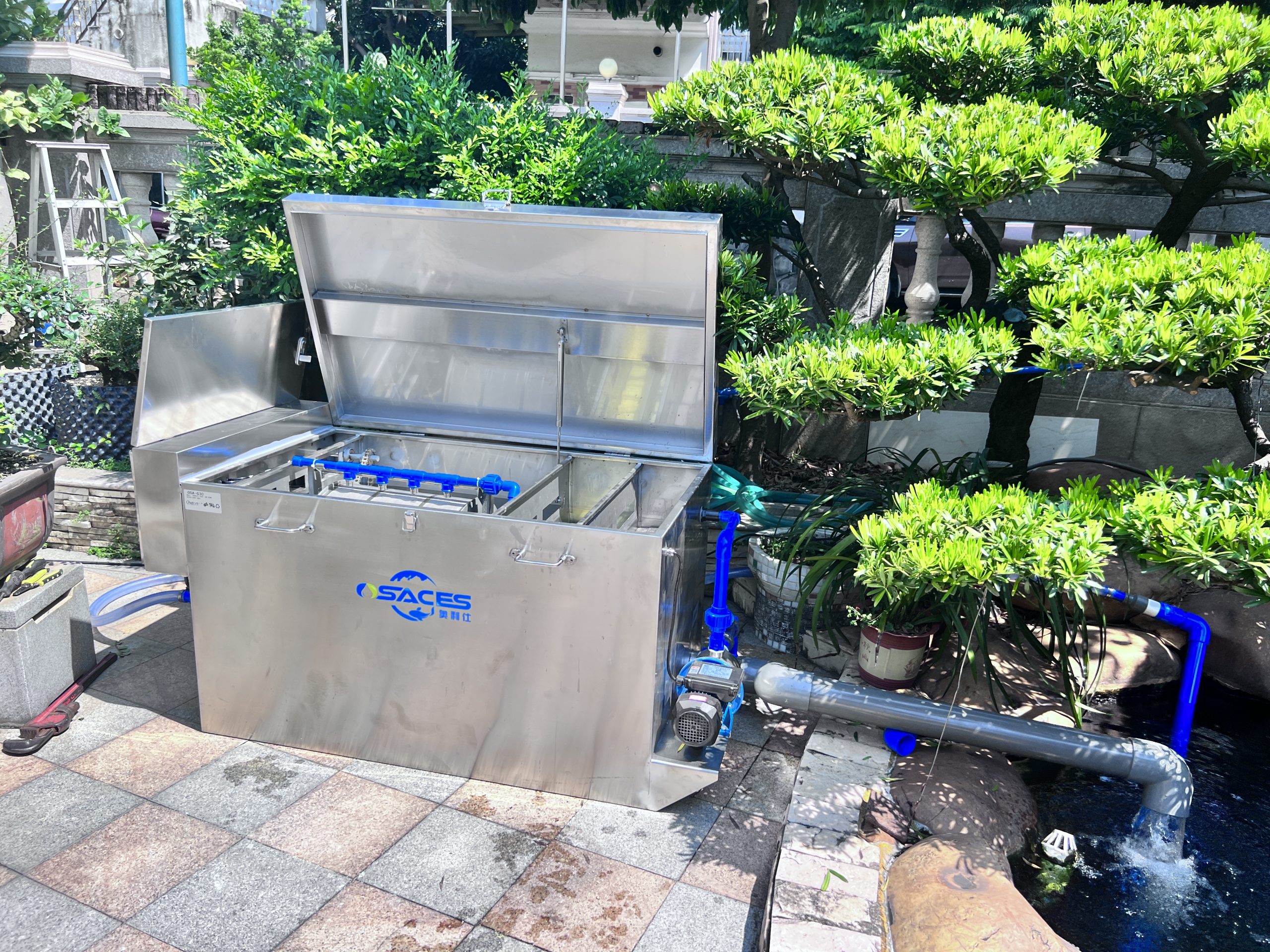
The 50 pounds of ceramic rings I laid in the biochemical silo of the integrated filtration equipment have a surface area equivalent to two standard basketball courts, and these honeycomb structures house two types of nitrifying elites: nitrite bacteria that can convert ammonia nitrogen into nitrites within 24 hours, and nitrate bacteria that proceed to oxidize it into relatively harmless nitrates. I did extreme testing last winter: after turning off the filtration for 12 hours, the ammonia concentration spiked from 0.01 mg/L to 0.8 mg/L, a value high enough to cause the most resistant grass carp to begin showing signs of neurotoxicity within 48 hours.
II. Dynamic equilibrium: an invisible stabilizer of water quality parameters
Many newbies are confused by the fact that fish always die for no apparent reason despite regular water changes. In fact, the problem lies in the drastic fluctuations in water quality: when the temperature difference between 1 ton of water exceeds 2℃, koi will produce a stress reaction equivalent to a heavy cold in humans; pH fluctuates by 0.3 units per hour, which is equivalent to letting the fish continue to be in a plateau reaction state.
My five-fold filtration system builds a powerful buffer system: the UV sterilization system kills 99% of harmful bacteria in time, and the UV germicidal lamps can damage biological DNA and eliminate unicellular chlorella in the water. The brushes in the physical filtration layer process 200m³ of water per hour, intercepting 90% organic matter to avoid corruption; the zeolite in the biochemical silo can adsorb the ammonia nitrogen that rises suddenly; the final clear water silo is equipped with heating rods to keep the temperature difference between the effluent water temperature and that of the main pool within 0.5°C. The water temperature difference between the effluent water and the main pool can be controlled by the UV light. Last summer's heavy rainfall caused the pH of the pool water to plummet from 7.4 to 6.8, and it was the continuous release of calcium carbonate from the coral bones in the filtration system that prevented a total wipeout.

III. Health barriers: from reactive treatment to proactive disease prevention
Veteran players who have experienced several full-pool wipeouts understand that the core of fish disease control is in the water and not in the medicine. When the concentration of suspended solids exceeds 30NTU, the particles will abrade the mucous membrane of the fish body like sandpaper, and this microscopic trauma is the breeding ground for the outbreak of water mold disease. My drip filtration system maintains water clarity at all times to the point where you can see the tile seams on the bottom of the pool through 6 layers of filter cotton of varying densities.
More critical is the stable output of dissolved oxygen. In the filtration system configured with anti-air lift device, dissolved oxygen can be stably maintained above 5mg/L. Under this value, the metabolic efficiency of fish is increased by 40%, and the production of vaccine antibody is accelerated by two times. Last year, when the introduction of new fish caused an outbreak of anchor fleas, it was thanks to the increase in the amount of mucus secreted by the fish in a high dissolved oxygen environment by 30% that an effective physical protective layer was formed.
IV. Ecological reconstruction: natural law in limited space
Some people question the filtration system against the laws of nature, but ignore the fact that natural water bodies have multiple purification mechanisms such as rainfall dilution, microbial decomposition and plant absorption. In the plant waterway I set up in the back section of the filtration bin, the planted Copperwort can absorb 180g of nitrate per month, which is equivalent to processing the metabolic waste of 2,000 adult peacock fish. When these nitrates are transformed into plant stems and leaves, they become food for plankton again, eventually forming a closed loop.
Even more subtle is the ecosystem's time-lag design: during the day the plants photosynthesize to consume carbon dioxide to raise the pH level, and at night the filtration system's air pumps continue to increase oxygen to avoid a pH plunge. This delicate balance was put to the test when the strongest heatwave in forty years hit last year - when outdoor temperatures reached 41°C, the water temperature in the core of my fish pond was cooled by the filtration system's circulation and kept below the 32°C safety line at all times.
V. Ultimate recommendations distilled from the lessons of the decade
Some fishermen have calculated that a 10 watt pump and 31 TP3T volume of filter media for 1 cubic meter of water is the cost effective choice. But my real-world experience is that a filtration system will always need 201 TP3T of performance redundancy. Those seemingly redundant filter media spaces can be the last line of defense to save an entire pool in case of a sudden rainstorm, power outage incident, or new fish carrying bacteria.
Fish farming is essentially a microbial war, and the filtration system is our military base to cultivate nitrifying bacteria special forces. When you see the gradual formation of brown bacteria film on the filter cotton, that is not just dirty, but also to protect the Great Wall of the waters of the love of fish. Behind these 1600 words is tens of thousands of dollars worth of dead fish in exchange for the knowledge, I hope you can take the road less traveled.
Related content
- 锦鲤的季节性充血应该如何预防?
- 春季鱼池过滤的注意事项
- 春节后别急着投喂!锦鲤肠胃的“重启指南”,喂对才能安全“出关”
- 从“勤换水”到“稳生态”:鱼池过滤观念的理性回归
- 全自动鱼池过滤器和普通鱼池过滤器的区别
- 养鲤干货:冬天一到,高手都在做这 3 件事!
- Fish Pond Filter Material Replacement Considerations
- 从零养鱼全攻略:用心经营一方水的生命力
Well-Known Case




 English
  Chinese
  Russian
  Spanish
  Portuguese
  German
  French
  Italian
  Japanese
  Korean